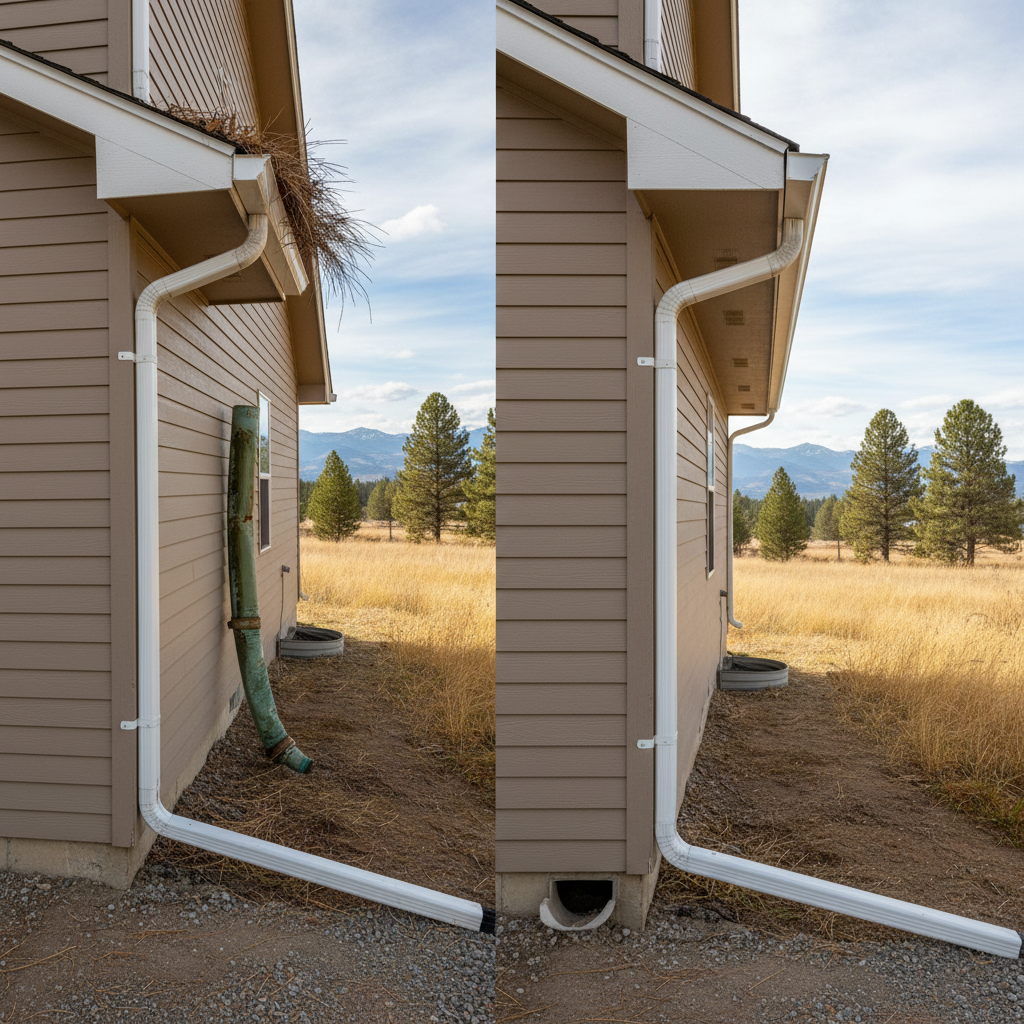
You're putting in new gutters, or maybe just upgrading your old downspouts, and now you're faced with a choice: do you run those downspouts above ground, or do you bury them? It's a common question I get from folks all over Great Falls, from the older homes in the Upper West Side to the newer builds out near Malmstrom.
Both options have their place, but they're not created equal, especially when you consider our specific conditions here in Montana. Let's talk about what I've seen work and what can cause headaches.
Above-Ground Downspouts: The Traditional Route
This is what most people picture: a downspout coming straight down from the gutter, usually ending with an elbow that kicks the water out a few feet from the foundation. It's the simplest setup, and for good reason.
Cost
Hands down, above-ground downspouts are cheaper to install initially. You've got the downspout itself, a few straps, an elbow, and maybe a splash block. Labor is minimal. If you're on a tight budget, this is your go-to.
Durability
They're pretty durable, actually. Modern aluminum or steel downspouts can take a beating from hail or stray branches. The biggest risk is usually someone backing into them with a car or a kid running into them on a bike. They're exposed, so they're vulnerable to physical damage, but the material itself holds up well to weather.
Maintenance
This is where above-ground really shines. If you get a clog, you can usually see it. A ladder, a hose, maybe a plumber's snake, and you're good to go. You can easily inspect them for cracks or damage. Keeping them clean is straightforward, and that's a big deal when you've got cottonwood fluff flying around in the spring or pine needles dropping in the fall.
Appearance
Some people don't like the look of downspouts running down the side of their house. They can break up the clean lines of your siding. However, with good color matching, they can blend in pretty well. And honestly, a well-installed, straight downspout doesn't look bad at all. It's functional architecture.
Buried Downspouts: Out of Sight, Out of Mind?
This option involves connecting your downspout to an underground pipe system that carries the water away from your foundation, often to a pop-up emitter in your yard or a drainage ditch. It sounds great on paper, right?
Cost
Expect to pay more for buried downspouts. You're not just buying the downspout; you're buying PVC or corrugated drain pipe, fittings, trenching labor, and possibly a pop-up emitter or connection to a storm drain. It's a bigger project, and it costs more upfront.
Durability
Once they're buried, they're protected from surface damage. That's a plus. However, the pipes themselves can be susceptible to crushing if not installed correctly, especially if heavy equipment drives over them. Tree roots are also a huge enemy of buried pipes – they'll find any tiny crack and exploit it, leading to clogs and blockages.
Maintenance
This is the big one, and often where people run into trouble. When a buried downspout clogs, it's a real pain. You can't just look at it and see the problem. You might need to rent a power snake, or even worse, dig up sections of your yard to find and clear the blockage. Here in Great Falls, with our clay-heavy soil, digging is no fun, and it can be tough on your landscaping. Plus, in winter, buried lines are prone to freezing, especially if they don't have enough slope or if water sits in them. A frozen, blocked line means water backs up right against your foundation, which is exactly what you're trying to avoid.
Appearance
This is the main draw for most people. No visible downspouts, no splash blocks, just a clean look around your foundation. If aesthetics are your absolute top priority, this is a strong contender.
My Recommendation for Great Falls Homeowners
Look, I've seen a lot of homes and a lot of drainage systems over the years. For most homeowners in Great Falls, I'm going to lean towards above-ground downspouts.
Why? Our climate. We get heavy snow, then rapid thaws. We get hard freezes. Buried lines are just too risky for freezing and subsequent foundation issues. The maintenance nightmare of trying to clear a frozen or root-bound underground pipe in the middle of winter or early spring is something you really want to avoid.
Yes, above-ground might not be as